
Best Landscaping Design Ideas for Buffalo NY Backyards in 2026
Buffalo winters are hard on a yard, so plan for them first. Evergreens and solid hardscaping keep the space looking decent from December through March. For the warm months, pick plants that can finish their growth in a short season. Anything you pour or stack, like patios and retaining walls, has to handle repeated freezing and thawing without heaving or cracking. Start the design in fall or winter, and you’ll be ready to break ground once the soil is workable in spring.
Most “backyard design ideas” lists online are written for climates with a six- or seven-month growing season. Buffalo isn’t one of those places. 716 Lawn Care’s landscaping design service works with Buffalo, NY’s shorter season and freeze-thaw conditions from the start, which means the ideas below are chosen specifically for what actually holds up here – not trends borrowed from a national blog that assumes your yard looks the same in November as it does in June.
Why Buffalo Backyards Need Different Design Choices Than National Trend Lists
A design idea that photographs well in a national magazine doesn’t automatically work in Western New York. Two local realities shape almost every good design decision here:
- A shorter growing season. WNY’s USDA zone 6a/6b climate means many ornamental plants are only doing their visual work for a few months a year. A design built entirely around flowering perennials looks bare from November through April.
- Freeze-thaw cycles. Repeated freezing and thawing puts real stress on hardscaping. Patios, walls, and walkways installed without the right base preparation can heave, crack, or shift within a few winters — something a warmer-climate design guide won’t warn you about.
Good Buffalo backyard design accounts for both from the planning stage, not as an afterthought.
Design With the Short Growing Season, Not Against It
A yard that only looks good in July is half a yard. Add things that don’t depend on leaves or flowers: evergreens, a solid patio, a low wall, a path you can still walk in February. Then the space has a reason to exist when everything else is dormant.
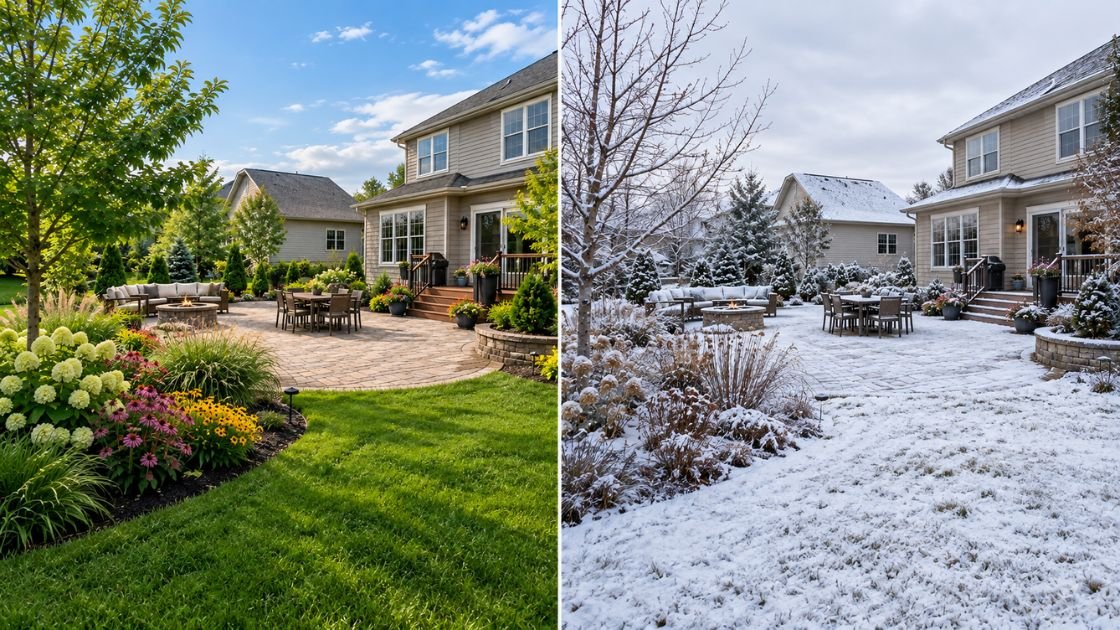
- Anchor the design with evergreens. Structural evergreens (arborvitae, boxwood, certain junipers suited to zone 6a/6b) hold their shape and color through winter, giving the yard a finished look even when perennials are dormant.
- Layer bloom times instead of clustering them. Choosing plants that flower in sequence — early spring bulbs, summer perennials, fall-blooming asters or sedums — stretches visual interest across more of the year than a single big summer bloom.
- Treat hardscaping as the year-round backbone. A patio, walkway, or retaining wall doesn’t go dormant. Leaning on hardscaping for structure means the yard has a strong “shape” even in months when plants aren’t contributing much.
Hardscaping Choices That Survive Freeze-Thaw Cycles
This is the part of a design that’s hardest to fix later, so it’s worth getting right the first time.
Patios: A patio’s long-term durability comes down to what’s underneath it, not just the surface material. A properly compacted gravel base with adequate depth below the frost line matters more in Buffalo’s climate than the paver style chosen on top.
Retaining walls: Sloped lots are common across WNY, and a retaining wall built without proper drainage behind it is one of the most common freeze-thaw failures we see — water gets trapped, freezes, expands, and pushes the wall out of alignment over a few seasons. If you’re dealing with a sloped or uneven lot, our Retaining Wall Installation article covers what a properly built wall needs in this climate.
Walkways: Similar rules apply — a walkway installed directly on unprepared soil is far more likely to shift and crack than one installed on a properly prepared base.
If a patio or wall in your design is a real investment, the base preparation is not the place to cut corners, even though it’s the part you won’t see once the project is finished.
Landscape designs Ideas for 2026
With those two principles in mind, here are the ideas actually worth considering for a Buffalo backyard this year:
- A defined patio “room.”
Rather than a single slab patio, many WNY homeowners are dividing outdoor space into a dining zone and a separate seating/fire zone, connected by a short walkway. This creates more usable space without requiring more square footage. - A fire feature for extended-season use.
A fire pit or fireproof feature lets you use a patio into September and October, when Buffalo evenings cool off quickly but the space is still very usable in the early evening. - Native and low-maintenance plantings.
Plants native to the Great Lakes region are generally better adapted to WNY soil and rainfall patterns than imported ornamentals, which can mean less watering and fewer replacement plants after a hard winter. - Mulched beds for moisture and weed control.
A properly mulched bed retains moisture through summer dry spells and suppresses weeds, reducing the maintenance load on planting beds through the growing season. - Outdoor lighting for early sunsets.
Buffalo loses daylight fast in fall — path lighting and simple accent lighting extend how much of the evening a backyard is actually usable, not just how it looks in daytime photos. - A retaining wall or terracing on sloped lots.
Beyond function, a well-built retaining wall can turn an awkward slope into usable, level space for a garden bed or small patio extension.
DIY vs. Hiring a Landscape Designer: What's Worth the Investment
Not every part of a backyard redesign requires a professional.
Reasonable to DIY:
- Planting a single bed or refreshing existing beds with new perennials
- Adding mulch to existing planting areas
- Installing simple garden edging
- Small decorative additions like planters or a few accent lights
Worth hiring a designer or contractor for:
- Any patio or walkway installation, since base preparation determines whether it lasts
- Retaining walls, which involve drainage and structural considerations that are difficult to correct after the fact
- A full-yard design plan, where the goal is a cohesive layout rather than individual additions
If your project is mostly planting and maintenance, doing it yourself is a completely reasonable choice. Where a professional design and installation earns its cost is anywhere freeze-thaw stress or drainage is involved — those are expensive mistakes to fix after the ground has already shifted a wall or cracked a patio.
Why Fall and Winter Are the Right Time to Plan (Not Wait)
Spring is when every WNY homeowner wants landscaping work done, which means design consultations and installation slots book up fast once the weather turns. Starting the design conversation in fall or winter means:
- Your plan, materials, and permitting (if needed for walls or larger structures) are settled before the spring rush
- You get an earlier installation slot instead of waiting behind projects booked ahead of you
- Plant selection can be finalized with enough lead time to source the right varieties for a spring planting window
Homeowners who wait until April to start planning a landscaping project are often competing for the same limited installation windows as everyone else who had the same idea at the same time.
Local Notes: Williamsville, Clarence Center, Lewiston
Backyard conditions vary enough across WNY suburbs that they’re worth mentioning:
- Williamsville lots tend to have more mature tree cover, which affects sunlight for planting beds — shade-tolerant plant choices often matter more here than in more open suburbs.
- Clarence Center properties are frequently larger, which opens up options like multi-zone patios or terraced slopes that wouldn’t fit a smaller in-city lot.
- Lewiston, being closer to the Niagara River, can have slightly different soil drainage patterns than inland Buffalo suburbs, which is worth factoring into bed and hardscape placement.
716 Lawn Care’s landscaping design service works across all three of these communities, adjusting plant and hardscaping choices to each property’s specific conditions.
Start Planning Your Backyard Now
A backyard design that actually holds up in Buffalo’s climate is decided months before the first shovel goes in the ground. If you’re ready to move past a list of ideas and into an actual plan, start your custom landscaping design project with 716 Lawn Care, and pair it with patio installation or a fresh round of mulching once your design is set.
FAQ
When is the best time to plan a landscaping design project in Buffalo, NY?
Fall and winter are the best times to plan, since spring installation slots book up quickly once warmer weather arrives. Starting the design process early means your project is ready to install as soon as the ground and weather allow.
What plants work best in Buffalo's climate for landscaping design?
Plants suited to USDA zone 6a/6b and native to the Great Lakes region generally hold up best, since they’re adapted to the area’s rainfall, soil, and winter conditions. Structural evergreens are also useful for maintaining visual interest through the off-season.
Why do some patios and walkways crack after a Buffalo winter?
Cracking and shifting usually happen when a patio or walkway wasn’t installed with a properly compacted base below the frost line. Freeze-thaw cycles put pressure on hardscaping that isn’t prepared for repeated expansion and contraction.
Do retaining walls need special design considerations in Buffalo?
Yes – retaining walls need proper drainage behind them to prevent water from getting trapped, freezing, and pushing the wall out of alignment over time. This is one of the most common failure points on sloped WNY lots.
Can I design and install a backyard landscaping project myself?
Simpler elements like planting beds, mulching, and small decorative touches are reasonable to do yourself. Patios, walkways, and retaining walls are usually worth hiring a professional for, since base preparation and drainage are difficult to correct after installation.
Reviewed by the 716 Lawn Care team. Updated October 2026.