Tree Trimming Cost in Buffalo, NY: Prices, Timing, and What to Expect
Tree trimming cost in Buffalo, NY depends mostly on how big the tree is, how hard it is to reach, and how much needs to come off. 716 Lawn Care’s tree trimming service in Buffalo, NY gives free written estimates, because no honest price can be set without seeing the tree. Below is what moves the price, when to book, and when DIY is fine.
How Much Does Tree Trimming Cost in Buffalo, NY?
Quick Answer: Tree trimming cost in Buffalo, NY depends on tree size, access, power-line proximity, how much is cut, and debris hauling. A small ornamental tree costs far less than a tall maple over a house, so reputable companies quote after seeing the tree. 716 Lawn Care provides free written estimates before work begins.
What Affects Tree Trimming Prices
Five factors set most tree trimming quotes: size, access, scope, hazards, and cleanup. Two trees of the same species can price very differently once these are counted.
Tree size and height
Taller, wider trees take more time, more equipment, and more crew. A mature maple or oak with a large crown costs more to trim than a small ornamental because every cut is higher, heavier, and slower to lower safely.
Access and location on the property
Trees in fenced backyards, behind houses, or on slopes cost more because crews must carry gear and branches farther. Easy truck access to the tree usually lowers the price.
Amount and condition of the work
Light shaping costs less than heavy limb reduction. Removing dead or storm-damaged wood can raise the price because those branches are unpredictable and need extra care.
Power lines and hazards
Trees near power lines cost more because the work must be done by electric-qualified crews. National Grid says tree work within 10 feet of electrical hazards should be done by workers specifically trained for it, and New York State law requires trained workers for tree work near overhead electric facilities. Homeowners are generally responsible for trimming branches near the service line running to their own house, and National Grid can temporarily disconnect that service line for a contractor on request.
Debris cleanup and hauling
Chipping, hauling, and disposal are separate labor. A quote that leaves branches piled at the curb will look cheaper than one that includes full cleanup, but the work is not equal.
What a Tree Trimming Quote Should Include
A good tree trimming quote is written, itemized, and specific about the trees and the cuts. Ask for these items before you accept a price:
- Which trees are included and where they are on the property
- What will be cut (dead wood, crown thinning, clearance from roof or driveway)
- Whether debris is chipped, hauled, or left behind
- Proof of liability and workers’ compensation insurance
- The total price and any extra charges
Be cautious of vague quotes, pressure to decide on the spot, or requests for full payment upfront. You can request a free estimate from 716 Lawn Care and compare it side by side with others.
When Is the Best Time to Trim Trees in Buffalo, NY?
For most trees, the best time to trim in Buffalo is late fall through winter, and dead or dangerous limbs should come off any time of year. Species and the reason for the work decide the rest.
Late fall and winter
Trees are dormant (leafless and not actively growing) in late fall and winter, so the branch structure is easy to see. Booking before heavy snow arrives gives weak limbs less chance to fail under lake-effect loads. Frozen ground also means less lawn damage from equipment.
Spring and summer
Spring and summer work suits light shaping, clearing branches off roofs, and removing dead wood, which is easy to spot when trees are in leaf. Some species, such as oaks, are often pruned outside the growing season.
After ice and lake-effect storms
Hanging or broken limbs after a storm should be handled promptly and from a safe distance. Never stand under a loaded branch, and never approach a limb touching a power line. National Grid notes that homeowners are responsible for removing storm-damaged trees and limbs from their property, even those utility crews cut from their lines.
Tree Trimming vs. Tree Pruning vs. Tree Removal
Trimming, pruning, and removal are three different jobs with three different price points. Companies often blur the terms, so ask for the actual cuts in writing.
What each one means
When trimming is enough
When removal is the safer choice
Tree trimming usually means cutting back branches to control size, clear structures, and tidy appearance. Tree pruning means removing specific branches to improve a tree’s health or structure. Tree removal means taking the whole tree down, and often grinding the stump.
If the trunk is sound and the problems are in the branches, trimming or pruning usually solves them. 716 Lawn Care offers trimming and pruning for these jobs.
Removal is safer when the trunk is cracked, hollow, or leaning with soil lifting at the base, or when most of the canopy is dead. 716 Lawn Care provides tree removal and stump grinding for those cases. A hazardous tree should be assessed by an insured crew.
Signs Your Tree Needs Trimming Now
A tree needs trimming now when you see dead wood, broken limbs, or branches touching your home. Look for these signs before winter:
- Dead, brittle, or leafless branches in summer
- Cracked or hanging limbs
- Branches rubbing against each other
- Limbs touching the roof, siding, or gutters
- Branches over the driveway or blocking sight lines
- Crowns so dense that snow piles up on them
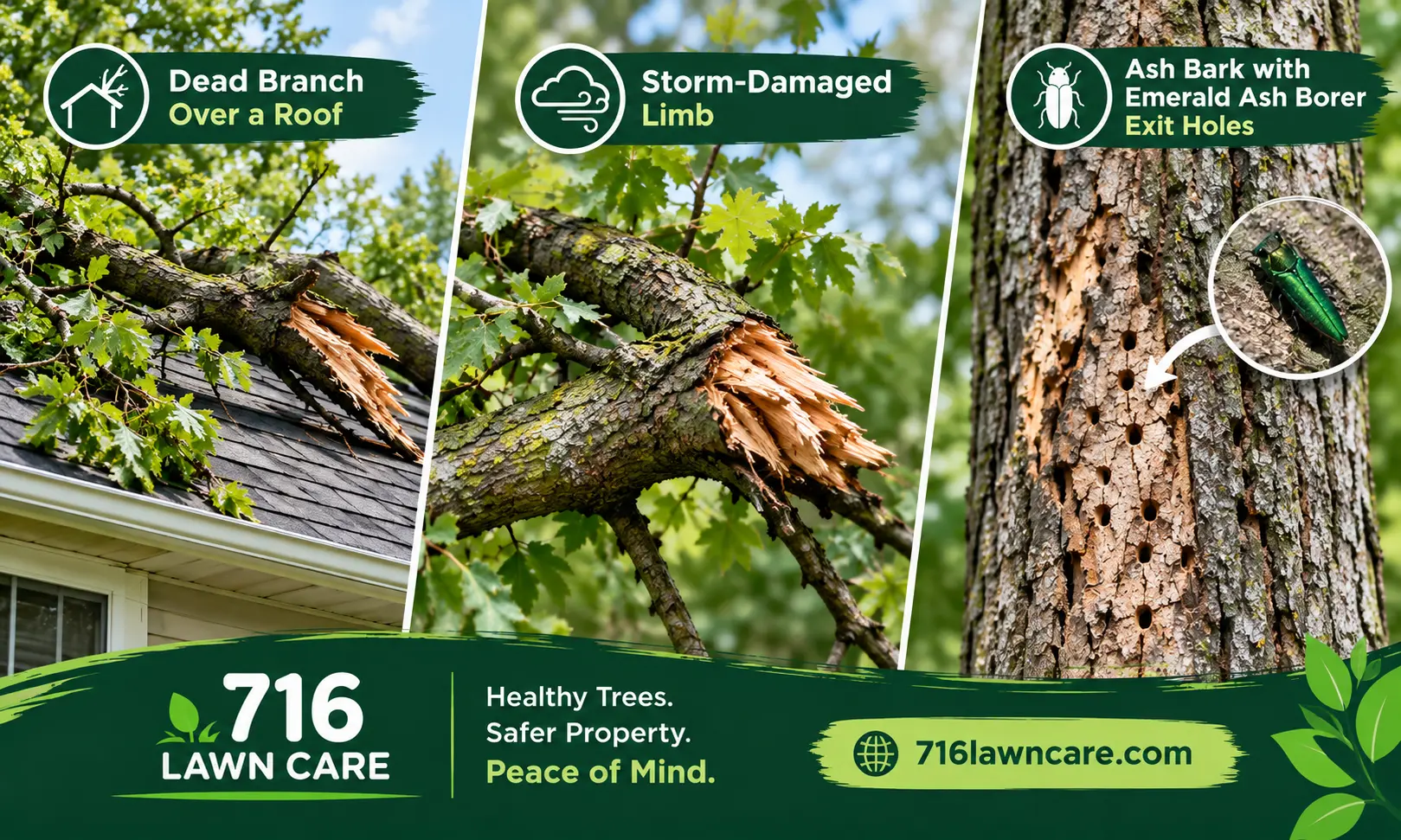
A branch that is cracked and overhangs your house is a priority. Waiting for the first heavy lake-effect storm is the most common way these turn into damage.
DIY Tree Trimming vs. Hiring a Professional
DIY tree trimming is reasonable for small branches you can cut from the ground with hand tools, and a professional is the right call for anything high, heavy, or near power lines.
| Job | DIY or pro? |
|---|---|
| Small low branches with hand pruners or loppers | DIY |
| Light shaping of shrubs and small ornamental trees | DIY |
| Branches above shoulder height needing a chainsaw | Pro |
| Limbs over a roof | Pro |
| Anything near power lines or service lines | Pro (electric-qualified) |
| Storm-damaged or hanging limbs | Pro |
| Large mature trees | Pro |
Ladders and chainsaws cause many tree-work injuries, so skip any cut that feels beyond your experience. Work near power lines is for trained crews only, and a branch touching a line should be reported to the utility.
Do You Need a Permit to Trim or Remove a Tree in Buffalo?
In the City of Buffalo, a DPW Tree Work Permit is required to prune, plant, or remove trees in the public right-of-way, and the permit has no fee. Residents may do minor pruning of the street tree in front of their house with hand tools (no chainsaws) without a permit. Trees on private property are handled differently, and the rules can change with location, size, or historic district status.
Need a Quote?
Request a free tree trimming estimate from 716 Lawn Care or call (716) 466-9969. Your estimate will be written, and the crew will tell you honestly if the tree only needs light work. Before winter, our winter lawn care guide for Buffalo covers the rest of your yard, and our projects page shows finished work.
Frequently Asked Questions About Tree Trimming in Buffalo, NY
How often should trees be trimmed?
Most mature trees benefit from trimming every few years, and young trees may need light shaping more often. Fast-growing species and trees near buildings may need attention sooner. A yearly check for dead or cracked branches before winter is a good habit.
Can you trim trees in winter?
Yes, winter is one of the best times to trim most trees in Buffalo because trees are dormant and the branch structure is easy to see. Dead or hazardous limbs can be removed any time. Avoid working on icy ground or in snow-loaded trees without a professional crew.
Does homeowners insurance cover tree trimming or removal?
Homeowners insurance typically does not cover routine tree trimming. It may cover removal when a tree falls on a covered structure because of a covered event such as a storm, but limits and conditions vary by policy. Check your policy or ask your insurer before work begins, and keep photos and written quotes.
Can I trim branches near power lines myself?
No, you should not trim branches near power lines yourself. National Grid says tree work within 10 feet of electrical hazards should be done by electric-qualified workers. Even branches near the line to your own home should be handled by trained crews, and a branch touching a line should be reported to the utility.
Is it cheaper to trim a tree once or on a regular schedule?
Regular light trimming is usually cheaper over time than one large cleanup, because small cuts are quicker and keep branches from becoming heavy or hazardous. A tree already neglected for years may need one bigger job first. Ask your company to recommend a schedule based on the tree.
Reviewed by the 716 Lawn Care team, updated October 2026.