
Snow Plowing Service in Buffalo NY: When Should You Sign Up?
If you want snow plowing in Buffalo, NY, sign up by mid-to-late October, before the first lake-effect storm. Plow companies build their routes around customers who have already committed, and those routes usually fill before the first big snowfall. If you call once it’s snowing, you’ll most likely land on a waitlist instead of getting service that week.
Every winter in Western New York, the first real snow brings a flood of calls to plowing companies. 716 Lawn Care’s snow plowing service covers residential driveways and commercial lots across Buffalo, Lackawanna, and Depew, and the routes we run each winter fill up long before that first snowfall does. The timing comes down to how snow removal company plan their seasons and how early lake-effect snow arrives here compared with most of the country.
Why Buffalo Plow Routes Fill Up Before the Snow Does
Plow companies plan their routes before the season starts, grouping customers by neighborhood so each truck can run a tight loop during a storm. Once a route fills, adding another address in the middle of it makes everyone on that route wait longer, so most companies stop taking sign-ups rather than overload a truck.
Buffalo makes this timing tighter than most cities. Lake-effect snow off Lake Erie can produce a legitimate accumulating snowfall as early as late October or early November, well before the “official” start of winter. Homeowners who wait until Thanksgiving to think about plowing are often trying to book into routes that were already locked weeks earlier.
When Should You Actually Sign Up?
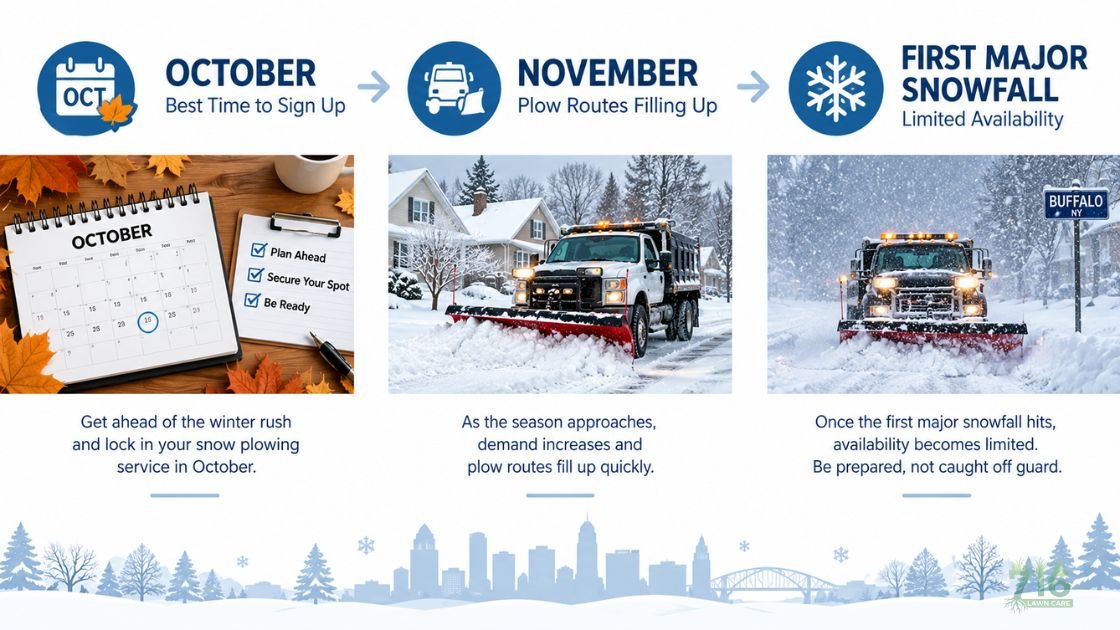
Mid-to-late October is the realistic window for most Buffalo-area homeowners and property managers. Here’s why that timing matters, not just “as soon as possible”:
- By October, routes are still forming. Companies are actively adding addresses and can still group you efficiently with nearby customers.
- By November, capacity is filling. You may still get service, but potentially on a newer, less-optimized route with a longer wait during storms.
- After the first snowfall, many companies are managing existing customers and can only take new sign-ups if a route has room — which isn’t guaranteed.
If you’re closer to the lake, in places like Lackawanna or parts of Depew, aim for the early end of that window. Lake-effect bands tend to hit these areas first and hardest.
Mid-to-late October is the realistic window for most Buffalo-area homeowners and property managers. Here’s why that timing matters, not just “as soon as possible”:
- By October, routes are still forming. Companies are actively adding addresses and can still group you efficiently with nearby customers.
- By November, capacity is filling. You may still get service, but potentially on a newer, less-optimized route with a longer wait during storms.
- After the first snowfall, many companies are managing existing customers and can only take new sign-ups if a route has room — which isn’t guaranteed.
If you’re closer to the lake, in places like Lackawanna or parts of Depew, aim for the early end of that window. Lake-effect bands tend to hit these areas first and hardest.
Residential vs. Commercial Snow Plowing: Different Timelines
| Property Type | When to Sign Up | Why |
|---|---|---|
| Residential Driveway | Mid-to-Late October | Grouped into neighborhood routes; earlier sign-up means better route placement. |
| Small Commercial Lot | Early October | Businesses often need faster response times for customer and employee access, so routes fill from the top down. |
| HOA / Multi-Property | Early October or Sooner | Multiple addresses need to be routed together, which takes more planning time. |
If you manage a commercial lot in Niagara Falls or a multi-property HOA, reaching out even earlier than October gives your plow provider room to plan a route that actually meets your access-time needs, rather than fitting you in around residential routes already built.
What a Buffalo Snow Plowing Contract Should Actually Cover
Before you sign anything, know what you’re agreeing to. A seasonal snow plowing contract in Buffalo typically spells out:
- Trigger depth — the snowfall amount (commonly around 2 inches) that automatically triggers a plow visit without you having to call.
- Response window — how soon after a storm ends your property gets plowed.
- Driveway vs. walkway coverage — plowing and shoveling/salting are often separate services or add-ons.
- Season length — many WNY contracts run roughly December through March, but confirm the exact start and end dates with your provider.
- Per-storm vs. seasonal pricing — seasonal contracts protect you from surprise costs in a heavy-snow winter; per-storm billing can be cheaper in a light winter but unpredictable in a bad one.
If you’re not sure which pricing structure makes sense for your property, that’s a reasonable thing to ask a provider directly rather than guessing — the right answer depends on your driveway size, how much risk you want to take on, and how heavy last winter was in your specific neighborhood.
Don't Forget Ice and Salt, Not Just Snow
Plowing clears snow, but ice is a separate problem, and it’s often the one that actually causes injuries and vehicle damage. Freeze-thaw cycles in Buffalo mean a driveway that’s clear at noon can refreeze into a sheet of ice by evening, especially on shaded or north-facing sections.
A few things worth confirming with any plow provider:
- Whether salting or de-icing is included in your plow contract or billed separately
- Whether they treat walkways and steps, not just the driveway — this matters most for households with older residents or anyone with mobility concerns
- What product they use — some de-icers are harder on concrete, plants, and pet paws than others, so it’s worth asking rather than assuming
If your plan doesn’t include ice treatment, keeping a bag of pet-safe ice melt on hand for the sections your plow service doesn’t cover is a simple, low-cost backup.
Do You Actually Need a Plow Service, or Is a Snowblower Enough?
This depends more on your driveway and physical situation than on marketing.
A snowblower or shoveling is often enough if:
- You have a short, flat driveway
- You’re physically able to clear snow regularly, including early mornings before work
- Your street doesn’t get heavy lake-effect accumulation
- You don’t need guaranteed timing (e.g., no early commute)
A plow service is worth it if:
- You have a long or steep driveway
- You need reliable clearing before a set time each morning
- You travel frequently in winter and can’t clear snow yourself
- Your property is in a heavier lake-effect zone
There’s no single right answer here – a homeowner with a short, flat driveway in a lighter-snow inland pocket may genuinely be fine with a snowblower, while someone with a long driveway near the lake will spend more time clearing snow themselves than a plow service would cost.
What Happens If You Wait Too Long
Waiting until the first snowstorm to look for plowing service usually means one of three outcomes: getting placed on a waitlist, getting added to an already-full route with a slower response time during storms, or paying a higher per-storm emergency rate instead of a locked seasonal price.
None of these are disasters, but all of them are avoidable by signing up in October instead of November.
Ready Before the First Snowfall
If you’ve been meaning to line up snow removal service this winter, mid-to-late October is when waiting begins to cost you a spot on a route. Reserve snow plowing with 716 Lawn Care now. While you’re at it, book a power washing visit this fall to clean your walkways and siding before salt and snow hit them, and put a spring cleanup on the calendar for when the snow melts.
FAQ
How much does snow plowing cost in Buffalo, NY?
Costs vary by driveway size, trigger depth, and whether you choose a seasonal contract or per-storm billing, so an accurate number depends on your specific property. Request a quote directly for pricing based on your driveway and service needs.
When does snow plowing season start in Buffalo?
Many seasonal contracts run from early-to-mid December through March, but lake-effect snow can arrive as early as late October, which is why sign-up should happen before the season officially starts.
What snow depth triggers a plow visit?
Many Buffalo-area contracts use a trigger depth around 2 inches, meaning your provider automatically plows once that much snow has accumulated, without you needing to call. Confirm the exact trigger with your provider, since it can vary by contract.
Is it too late to sign up for snow plowing after the first snowfall?
It’s not necessarily too late, but routes fill quickly once the season starts, so you may be placed on a newer route with a longer response time or added only if capacity allows.
Do I need a separate service for walkway shoveling and salting?
Often yes – plowing typically covers driveways, while walkway shoveling and salting are separate services or add-ons, so confirm what’s included before signing a contract.
Is a snowblower enough, or do I need a plow service?
A snowblower can be enough if your driveway is short and flat and you don’t need it cleared by a particular time. If your driveway is long or steep, you leave for work early, or you live in a heavier lake-effect zone, a plow contract usually makes more sense.